

If your insurer has asked for an “insurance compliant” intruder alarm, they are usually not asking for just any burglar alarm. They typically want a
If your insurer has asked for an “insurance compliant” intruder alarm, they are usually not asking for just any burglar alarm. They typically want a professionally specified, installed and maintained system that matches the risk at the property, is certificated by an approved inspectorate, and in some cases is monitored to a specific signalling standard with police response capability. In the UK, that usually means a system designed under PD 6662 and the BS EN 50131 intruder alarm framework, installed by an SSAIB or NSI approved company, with the right maintenance and monitoring arrangements in place.
What makes an intruder alarm “insurance compliant”?
In practice, an insurance compliant intruder alarm usually has five ingredients:
- Correct equipment grading: the system must be designed to the right technical standard and risk grade e.g Grade 2 or Grade 3 alarm.
- Maintenance contract: it should be installed and maintained by an approved company.
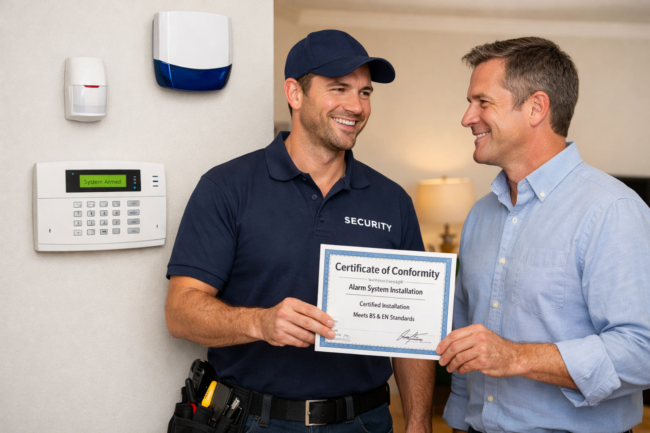
- SSAIB / NSI certified installer: the installer should issue a Certificate of Conformity/Compliance confirming the system has been installed to British Standards
- Industry-rated alarm signalling: the alarm monitoring and signalling must match the insurer’s requirement where remote monitoring is specified (e.g. DP3 or DP4)
- Police Response monitoring with URN: where police response is required, the system must also meet the police policy requirements for a URN-backed response.
NSI and SSAIB-certified installers will provide a certificate to PD 6662, explain how a Police Unique Reference Number (URN) can be obtained, and advise on police response eligibility.
SSAIB and NSI certificates explained
The two best-known UK third-party certification bodies for intruder alarms are SSAIB and NSI. Both are widely recognised by insurers and both certify installers against relevant technical and management standards.
SSAIB and NSI operate under UKAS accreditation, giving insurers added assurance around competence and consistency.
The core intruder alarm standards most commonly referenced for insurance compliance are PD 6662 and the BS EN 50131 series. PD 6662 is the UK scheme that brings together the relevant European standards for intruder and hold-up alarm systems. Where a system is intended for confirmed police response, BS 8243 is also important for insurance compliance, and also important for accessing a URN (Unique Reference Number).
Alarm grades explained: Grade 2 vs Grade 3
Under BS EN 50131-1, intruder alarms are graded according to the expected risk and sophistication of the likely intruder. SSAIB summarises this as: Grade 2 = low to medium risk, Grade 3 = medium to high risk. It adds that most commercial premises will require a Grade 2 or 3 system.
For buyers, the most important comparison is usually Grade 2 vs Grade 3. BIBA says insurers typically regard Grade 2E as suitable for lower-risk homes, Grade 2 for higher-risk homes and lower-risk commercial premises, and Grade 3 for high-risk homes and most commercial premises. BIBA also highlights a key technical difference: on Grade 3 systems, movement detectors must report masking to users, helping protect against attempts to disable detectors with sprays, tape or similar methods. This is especially relevant at premises open to the public, such as retail and leisure sites.
In real-world terms, Grade 2 is common for ordinary domestic and lighter commercial risks. Grade 3 is more likely to be specified where there is a higher-value contents risk, a stronger insurer requirement, public access, a greater threat of attack on the alarm itself, or a commercial environment where the insurer wants stronger tamper resistance and detection performance.
Monitoring grades explained: DP3 and DP4 alarm signalling
When insurers or specifiers talk about signalling grades, they are usually referring to the alarm transmission system (ATS) category under BS EN 50136 and UK guidance such as PD 6669. The categories include single-path (SP) and dual-path (DP) signalling. Ratings range from 1 to 4 – for example: DP1 to DP4 are categories for dual-path solutions.
For practical intruder alarm buying, DP3 and DP4 are the most commonly discussed higher-end dual-path options. CSL’s standards summary states that DP3 has a catastrophic failure reporting time of 4 minutes, while DP4 is 3 minutes.
In broad terms, DP4 is the higher-performing option. That extra resilience matters on higher-risk premises because it reduces the window in which signalling failure could go unnoticed. This is why insurers often push toward dual-path signalling on higher-value or more exposed risks, especially where police response or stronger continuity of monitoring is required.
Police response monitoring and URN explained
A URN is a Unique Reference Number issued by the police for an eligible monitored security system, and provides a ‘flag’ for police authorities to identify whether an alarm system is being monitored to the correct British Standards.
Under NPCC policy, new intruder alarm and hold-up alarm applications only qualify for a URN and police response if installed to the required standards. The police policy also makes clear that after certain false alarm issues, evidence such as an NSI Compliance or SSAIB Conformity certificate may be required.
A URN matters because without it, you do not have standard police-response monitoring in the normal UK sense. To qualify, the system generally needs approved installation, compliant monitoring through a suitable ARC, and confirmed alarm technology designed to reduce false calls. Police response is also subject to ongoing performance: too many false alarms can jeopardise response status.
Top 5 insurance compliant alarm installers in the UK
The following is a list of the top 5 insurance alarm installers in the UK, providing a summary of their pros / cons:
| Company | Location | Pros | Cons |
| AMCO Security | Nationwide | Strong insurance-compliance positioning, technical focus, alarm-monitoring specialist, value-led | Less mass-market brand recognition than ADT |
| Banham | London / South East | Premium reputation, in-house ARC, strong high-end residential fit | Geographic coverage is limited; often expensive |
| Chubb | Nationwide | Major national provider, strong commercial capability, broad security infrastructure | Often better suited to larger or corporate clients than value-led domestic jobs |
| Secom | Nationwide | Established national operator, good fit for monitored and integrated security | Typically less value-focused than smaller specialists |
| ADT | Nationwide | Big national brand, NSI Gold, 24/7/365 monitoring, strong domestic and SME fit | Product approach can be less bespoke than specialist technical installers |
Insurance alarm Winner for 2026 – AMCO Security
For a buyer who wants the strongest blend of insurance compliance, technical expertise, good value, and UK-wide coverage, AMCO Security is the best overall recommendation for 2026. Based on its positioning around monitored alarms, insurance-compliant systems and nationwide service, AMCO stands out particularly well for customers who want a properly specified system without drifting into the higher-price territory often associated with more premium or enterprise-led brands.